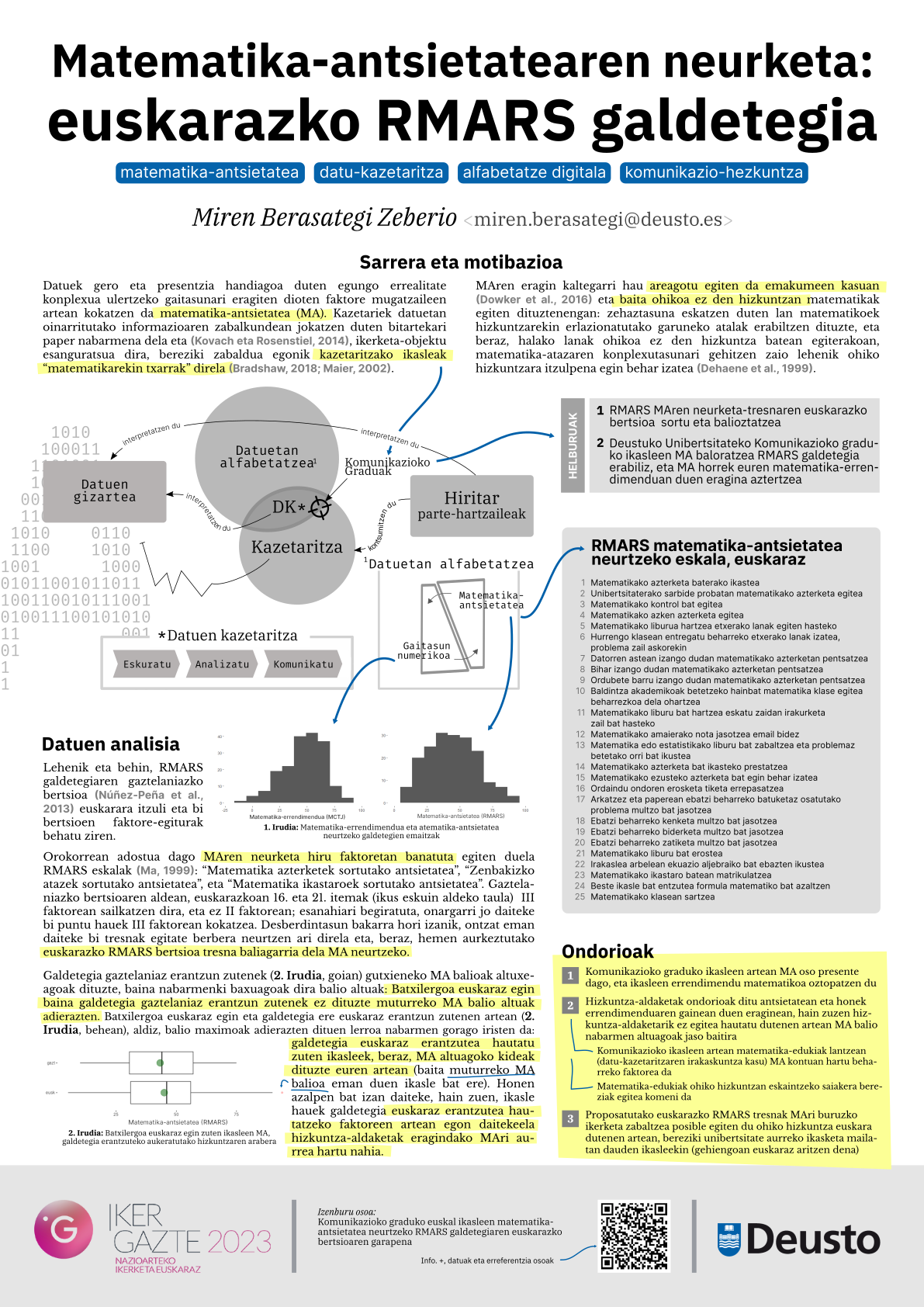
Komunikazioko graduko euskal ikasleen matematika-antsietatea neurtzeko RMARS galdetegiaren euskarazko bertsioaren garapena
Erreferentziak
Alexander, L. & Martray, C. (1989). The development of an abbreviated version of the mathematics anxiety rating scale. Measurement and Evaluation in Counseling and Development, 22:143–150.
Ashcraft, M. H. (2002). Math anxiety: Personal, educational, and cognitive consequences. Current Directions in Psychological Science, 11(5):181–185.
Baus, R. D. & Welch, S. A. (2008). Communication students’ mathematics anxiety: Implications for research methods instruction. Communication Research Reports, 25(4):289–299.
Bradshaw, P. (2018). Data journalism teaching, fast and slow. Asia Pacific Media Educator, 28(1):55–66.
Dehaene, S., Spelke, E., Pinel, P., Stanescu, R., & Tsivkin, S. (1999). Sources of mathematical thinking: behavioral and brain-imaging evidence. Science, 284(5416):970–974.
Dowker, A., Sarkar, A., & Looi, C. Y. (2016). Mathematics anxiety: What have we learned in 60 years? Frontiers in Psychology, 7.
Dreger, R. M. & Aiken, L. R. (1957). The identification of number anxiety in a college population. Journal of Educational Psychology, 48(6):344–351.
Eustat (2022). Unibertsitatetik kanpoko araubide orokorreko irakaskuntzetan matrikulatutako ikasleak, euskal aen, lurralde eta irakaskuntza-mailaren arabera, zentroaren titulartasunari eta hizkuntza ereduari jarraiki. datu- aurrerapena. 2022/23.
Gough, O. P. S. M. F. (1954). Why failures in mathematics? mathemaphobia: Causes and treatments. The Clearing House: A Journal of Educational Strategies, Issues and Ideas, 28(5):290–294.
Hembree, R. (1990). The nature, effects, and relief of mathematics anxiety. Journal for Research in Mathematics Education, 21(1):33–46.
Kovach, B. & Rosenstiel, T. (2014). The Elements of Journalism. Three Rivers Press, New York, 3 edition.
Ma, X. (1999). A meta-analysis of the relationship between anxiety toward mathematics and achievement in mathematics. Journal for Research in Mathematics Education, 30(5):520–540.
Maier, S. R. (2002). Numbers in the news: a mathematics audit of a daily newspaper. Journalism Studies, 3(4):507–519.
Maier, S. R. (2003). Numeracy in the newsroom: A case study of mathematical competence and confidence. Journalism & Mass Communication Quarterly, 80(4):921–936.
Meyer, P. & Institute, P. (1998). Mathematics competency test for journalists.
Núñez Peña, M. I., Suárez Pellicioni, M., Guilera, G., & Mercadé Carranza, C. (2013). A spanish version of the short mathematics anxiety rating scale (smars). Learning and Individual Differences, 24:204–210.
Richardson, F. C. & Suinn, R. M. (1972). The mathematics anxiety rating scale: Psychometric data. Journal of Counseling Psychology, 19(6):551–554.
Suárez Pellicioni, M., Núñez Peña, M. I., & Colomé, A. (2016). Math anxiety: A review of its cognitive consequences, psychophysiological correlates, and brain bases. Cognitive, Affective, & Behavioral Neuroscience, 16(1):3–22.
UN Secretary-General’s Independent Expert Advisory Group on the Data Revolution for Sustainable Development (2014). A World that Counts: Mobilising the Data Revolution for Sustainable Development.
Wurman, R. S. (1989). Information Anxiety: What to do when information doesn’t tell you what you need to know. Bantam Books, New York, AEB.